18 Wheeler Accident vs Car Accident Claims: Key Differences in Texas
Navigating the aftermath of any vehicle accident in Texas can be a daunting experience, but the complexities multiply significantly when an 18-wheeler is involved.
While both car accidents and commercial truck accidents fall under the umbrella of personal injury law.
But the sheer scale, regulations, and potential damages associated with an 18-wheeler collision create a distinct and far more challenging legal landscape.
This article discusses how these differences impact victims and their ability to recover fair compensation.
Understanding these key distinctions is not just beneficial, it's critical for anyone involved in such a catastrophic event.
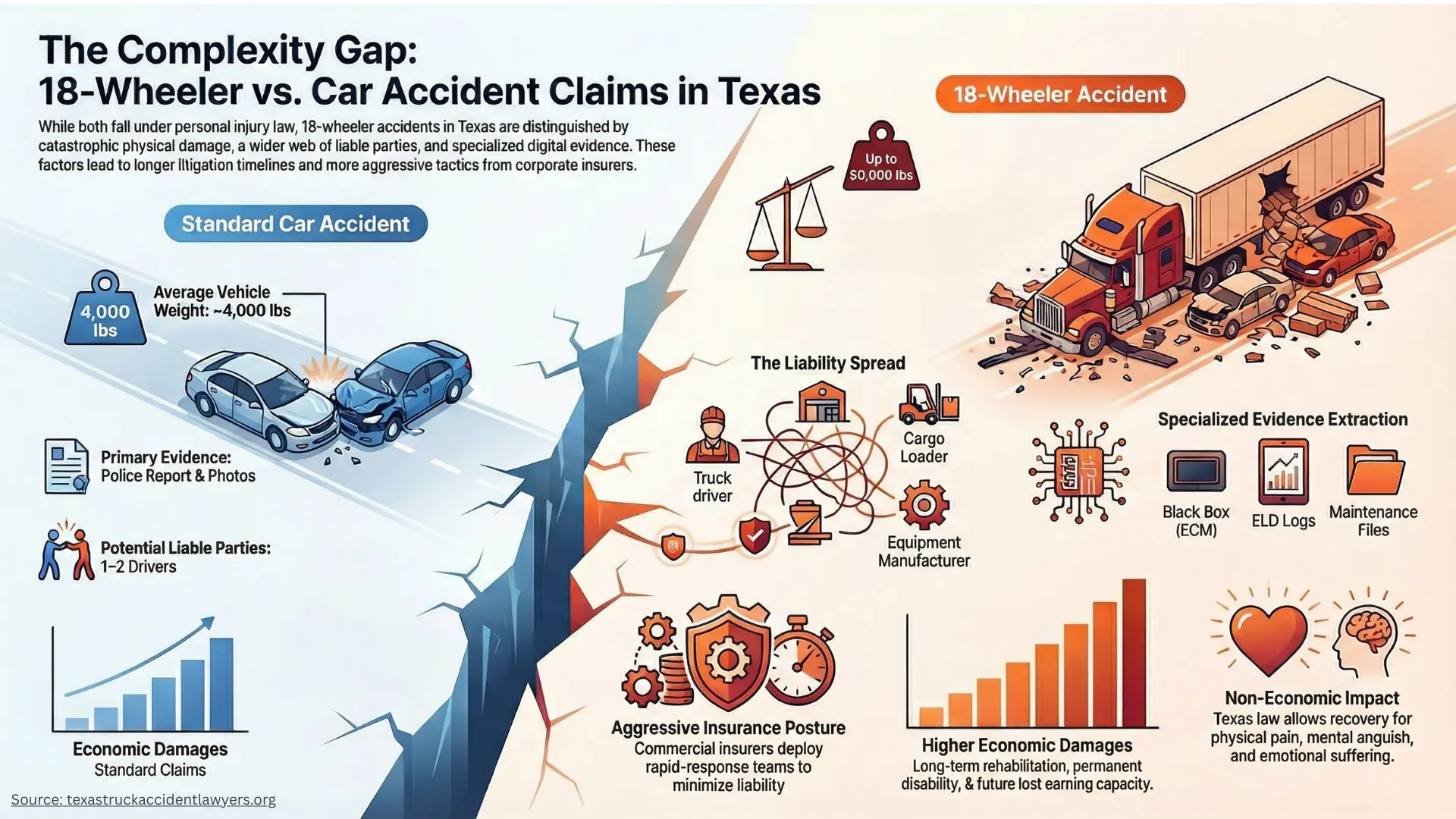
Key Takeaways
- The fundamental differences between 18-wheeler and car accident claims in Texas boil down to several core areas.
- First, the severity of injuries in truck accidents is almost always greater, leading to higher medical costs and long-term care needs.
- Second, the spread of liability is far wider, involving not just the driver but potentially the trucking company, cargo loaders, manufacturers, and maintenance providers.
- Third, the types of evidence available and required are vastly more complex, including specialized data from electronic logging devices and black boxes.
- Fourth, the posture of insurers for trucking companies is typically more aggressive and sophisticated.
- Finally, the timelines for investigation, negotiation, and litigation are generally extended due to these intricate factors.
- Recognizing these distinctions from the outset is vital for building a strong case and securing justice.
Key Differences in Texas 18-Wheeler vs Car Accidents
The most immediate and stark difference between an 18-wheeler accident and a standard car accident is the potential for catastrophic injury or wrongful death.
An average passenger vehicle weighs around 4,000 pounds, while a fully loaded 18-wheeler can weigh up to 80,000 pounds.
This immense disparity in size and weight means that in a collision, occupants of smaller vehicles are at an extreme disadvantage, often sustaining devastating injuries.
Common injuries in 18-wheeler accidents include:
- Traumatic Brain Injuries (TBIs) TBI claims in TX truck crashes
- Spinal Cord Injuries, leading to paralysis
- Multiple fractures and crush injuries
- Internal organ damage
- Severe burns
- Amputations
- Wrongful death claims in Texas truck accidents
These injuries often require extensive, long-term medical treatment, multiple surgeries, rehabilitation, and may result in permanent disability, affecting a victim's ability to work and enjoy life.
The economic and non-economic damages in such cases are significantly higher, encompassing not only current medical bills and lost wages but also future medical care, lost earning capacity, pain, suffering, and mental anguish.
In Texas, pain and suffering is considered a part of non-economic damages, covering physical pain, mental pain, emotional anguish, and loss of enjoyment of life.
For wrongful death claims, the Texas Civil Practice and Remedies Code Section 71.002 allows certain family members to seek compensation when a loved one's death results from another party's wrongful act, neglect, carelessness, or default.
In contrast, while car accidents can certainly cause serious injuries, they are statistically less likely to result in the same level of catastrophic harm or fatality.
The lower injury threshold in car accidents often translates to less complex medical evidence and lower overall damage claims.
Spread of Liability in 18-Wheeler Accidents
Determining fault in a car accident typically involves identifying one or two at-fault drivers. However, in an 18-wheeler accident, the web of potential liability can extend far beyond just the truck driver.
This "liability spread" is a critical difference:
- Truck Driver: The driver can be liable for negligence such as speeding, distracted driving, fatigued driving (violations of Hours-of-Service regulations), or driving under the influence.
-
Trucking Company/Motor Carrier: The company employing the driver can be held vicariously liable for their driver's actions under the principle of respondeat superior. Beyond that, they can be directly liable
for their own negligence, including:
- Negligent hiring or retention (e.g., hiring a driver with a poor safety record).
- Negligent training or supervision.
- Pressuring drivers to violate hours-of-Service (HOS) regulations.
- Failure to properly maintain the truck.
- Failure to conduct mandatory drug and alcohol testing.
- Cargo Loader/Shipper: If the cargo was improperly loaded or secured, leading to a weight shift or spilled load, the party responsible for loading could be held liable.
- Truck Manufacturer/Parts Manufacturer: A defect in the truck's design or a faulty component (e.g., brakes, tires) could make the manufacturer liable under product liability laws.
- Maintenance Company: If a third-party company was responsible for maintaining the truck and performed negligent repairs, they could share fault.
Texas operates under a modified comparative negligence rule, also known as proportionate responsibility, as outlined in the Texas Civil Practice & Remedies Code, Chapter 33.
This means that if multiple parties contribute to an injury, a judge or jury assigns percentages of fault.
A victim can still recover damages even if they are partially at fault, but their compensation will be reduced by their percentage of fault.
However, if the injured party is found to be more than 50% responsible for the accident, they are barred from recovering any compensation.
This complex multi-party liability in truck accidents necessitates a thorough investigation to identify all potentially at-fault parties and maximize a victim's recovery.
Read More: Who can be liable in Texas truck accidents?
Types Of Evidence in 18-Wheeler Claims
The evidence crucial to an 18-wheeler accident claim is far more extensive and specialized than what is typically found in a car accident case.
While both rely on police reports, witness statements, and photographic evidence, truck accidents demand a deeper dive into commercial regulations and vehicle technology.
Common causes and evidence are logs, black boxes/ECMs, maintenance, and hours-of-service.
Key evidence unique to 18-wheeler accidents includes:
- Black Box Data (Event Data Recorder/Electronic Control Module - EDR/ECM): Similar to an airplane's black box, these devices record critical data such as speed, braking, throttle position, engine RPM, steering input, and seatbelt usage in the moments before and during a crash. This objective data is invaluable for reconstructing the accident and proving negligence. Trucking companies typically own this data, but lawyers can obtain it through preservation letters or court orders.
- Electronic Logging Devices (ELDs): Mandated by the FMCSA, ELDs record a driver's Hours-of-Service (HOS) to prevent fatigued driving. Violations of HOS regulations can be strong evidence of negligence.
- Driver Qualification Files: These files contain the driver's employment history, medical examination results, drug and alcohol test results, and driving record.
- Maintenance and Inspection Records: Evidence of neglected maintenance can point to the trucking company's liability.
- Cargo Manifests and Loading Documents: These can reveal if the truck was overloaded or improperly loaded.
- Company Policies and Training Manuals: These documents can show if the trucking company failed to adhere to industry standards or its own safety protocols.
The immediate preservation of this evidence is paramount. Trucking companies are often quick to secure or even destroy incriminating evidence.
Sending a spoliation letter immediately after an accident is crucial to legally compel the trucking company to preserve all relevant data and documents.
Commercial Trucking Insurers vs. Standard Auto Insurers
Dealing with insurance companies after an accident is always challenging, but the difference in posture between a standard auto insurer and a commercial trucking insurer is significant.
Trucking companies are backed by large corporate insurance carriers with vast resources and aggressive legal teams.
These insurers understand the high stakes involved due to the potential for catastrophic damages and multi-party liability.
Their strategies often include:
- Rapid Response Teams: Trucking companies frequently dispatch their own investigators, adjusters, and attorneys to the accident scene almost immediately. Their goal is to control the narrative, gather favorable evidence, and minimize their client's liability.
- Aggressive Denials and Lowball Offers: They are notorious for disputing fault, downplaying injuries, and offering quick, low settlements in an attempt to resolve claims before victims fully understand the extent of their damages or seek legal counsel.
- Sophisticated Legal Defenses: They employ experienced defense attorneys who specialize in complex commercial litigation and are well-versed in federal trucking regulations (FMCSA).
- Blame Shifting: They will vigorously attempt to shift blame to the injured party or other entities to reduce their payout.
In Texas, insurance companies have a duty of good faith and fair dealing.
Violations of the Texas Insurance Code, particularly Chapters 541 and 542, can lead to claims of bad faith insurance practices if an insurer unreasonably denies, delays, or underpays legitimate claims.
However, proving bad faith against a powerful trucking insurer requires an attorney with specific experience in insurance negotiations and bad faith in Texas truck accident cases.
Timelines of Texas 18-wheeler accident claim
The timeline for resolving an 18-wheeler accident claim in Texas is almost always longer than that for a typical car accident.
This extended timeline is a direct consequence of the increased complexity in terms of injury severity, liability investigation, and evidence gathering. Key factors contributing to the longer timeline include:
Initial Investigation: Gathering all necessary evidence, including black box data, ELD records, maintenance logs, and driver files, takes significant time and often requires legal action (e.g., subpoenas, preservation letters).
Medical Treatment and Prognosis: Because injuries are often severe, it can take months or even years for victims to reach maximum medical improvement (MMI) and for doctors to provide a clear prognosis for long-term care and disability. A claim cannot be fully valued until the full extent of damages is understood.
Negotiations: The multi-party liability and high stakes often lead to protracted negotiations with multiple insurance carriers.
Litigation: If a fair settlement cannot be reached, the case may proceed to litigation, which can involve extensive discovery, depositions, expert witness testimony, and potentially a trial, adding years to the process.
Despite the extended process, it is crucial to act quickly. The Texas statute of limitations for personal injury claims, including those arising from truck accidents, is generally two years from the date of the accident.
For wrongful death claims, the statute of limitations is also two years, but it begins from the date of death. While there are limited exceptions, missing this deadline almost certainly means losing the right to pursue compensation.
FAQs
- Q: What should I do immediately after an 18-wheeler accident in Texas?
- A: Your first priority is safety and medical attention. If possible, move to a safe location, call 911, and seek immediate medical care. Document the scene with photos and videos, and get contact information from witnesses. Most importantly, contact an experienced Texas truck accident attorney as soon as possible to protect your rights and ensure critical evidence is preserved.
- Q: Can I sue the trucking company directly?
- A: Yes, in most cases, you can sue the trucking company in addition to the driver. Trucking companies can be held liable for their own negligence (e.g., negligent hiring, improper maintenance) and vicariously for the actions of their drivers.
- Q: How are damages calculated in an 18-wheeler accident case?
- A: Damages typically include economic damages (quantifiable losses like medical expenses, lost wages, property damage, and future lost earning capacity) and non-economic damages (subjective losses like pain and suffering, mental anguish, disfigurement, and loss of enjoyment of life). In cases of egregious conduct, punitive damages (also known as exemplary damages in Texas) may also be awarded to punish the at-fault party and deter similar behavior. Texas law caps punitive damages in most personal injury cases.
- Q: Is the statute of limitations different for truck accidents than car accidents in Texas?
- A: No, the general Texas statute of limitations for personal injury and wrongful death claims is two years from the date of the accident or death for both car and truck accidents. However, claims against a governmental entity may have a shorter notice period, sometimes as little as six months.
- Q: Why do I need a specialized Texas truck accident lawyer?
- A: The complexities of 18-wheeler accident claims – including federal regulations (FMCSA), multi-party liability, specialized evidence, and aggressive corporate insurers – demand an attorney with specific experience and resources in this niche area of law. A general personal injury lawyer may not have the in-depth knowledge or the financial capacity to take on such formidable opponents.