What to Do Right After a Truck Accident in Texas (Checklist)
Being involved in a truck accident in Texas can be a traumatic and life-altering event.
Unlike standard car collisions, wrecks involving commercial trucks often result in catastrophic injuries and complex legal challenges.
The sheer size and weight of an 18-wheeler can lead to devastating consequences, and the aftermath requires swift, informed action to protect your health and legal rights.
As a Senior Texas Personal Injury Attorney, I understand the critical steps you must take immediately following such an incident.
This checklist provides essential guidance to navigate the chaotic moments after a truck crash in Texas.
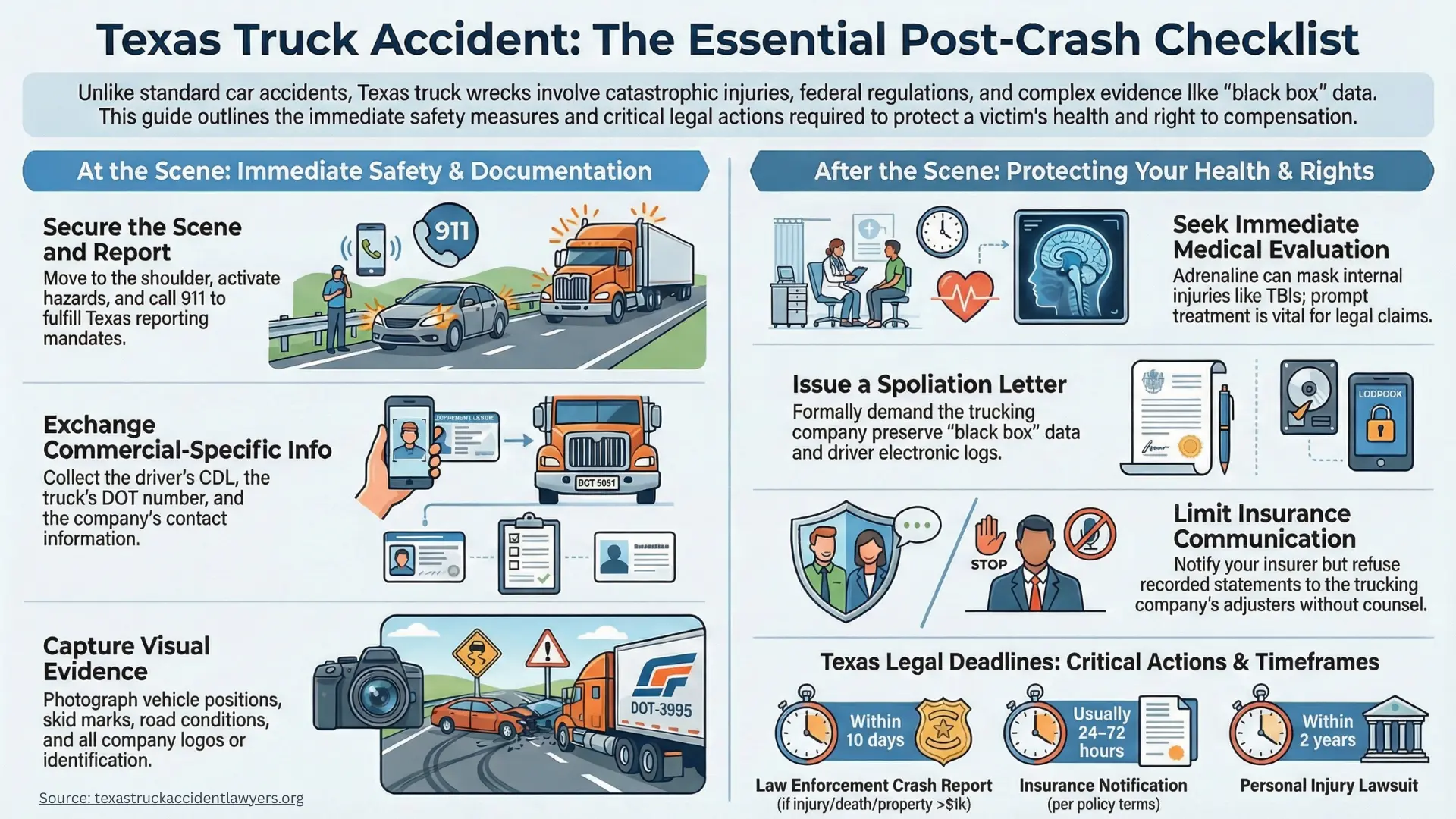
Key Takeaways
- Prioritize safety and seek immediate medical attention, even if injuries seem minor.
- By law, you must stop at the scene, exchange information, and render reasonable aid if injuries are apparent.
- Report the accident to law enforcement promptly, especially if there are injuries, fatalities, or significant property damage.
- Document the scene thoroughly with photos, videos, and witness information.
- Notify your insurance company as soon as possible, but be cautious about what you say.
- Crucially, take steps to preserve evidence, including sending a spoliation letter through an attorney, as trucking companies may quickly try to conceal crucial data.
Immediate Safety
Your safety and the safety of others should be your absolute first priority after a truck accident.
The scene of a truck crash can be incredibly dangerous due to potential hazards like spilled fuel, broken glass, debris, and ongoing traffic.
Taking immediate safety measures can prevent further injury or tragedy.
- Assess for Injuries: First, check yourself and any passengers for injuries. Even if you feel fine, adrenaline can mask pain.
- Move to Safety (If Possible and Safe): If your vehicle is operational and it is safe to do so, move it to the shoulder or a nearby safe location, away from the flow of traffic. However, if anyone is injured or your vehicle cannot be moved safely, leave it in place. Under the Texas Transportation Code, if an accident occurs on a freeway in a metropolitan area and vehicles can be safely driven, operators have a duty to move their vehicles to a suitable location to minimize interference with traffic.
- Turn on Hazard Lights: Activate your vehicle's hazard lights to alert other drivers to the presence of an accident.
- Set Up Flares or Warning Triangles: If you have them and it's safe to do so, place flares or reflective warning triangles around the accident scene to increase visibility for oncoming traffic.
- Do Not Approach the Truck if Unsafe: Commercial trucks can be unstable after a collision. Avoid approaching the truck if there's any risk of fire, explosion, or shifting cargo.
Call & Report
Reporting the accident to the proper authorities is not only a crucial step for your legal claim but also a legal obligation in many circumstances in Texas.
- Call 911 Immediately: If there are any injuries, fatalities, or significant property damage, call 911 without delay. This will dispatch emergency medical services, fire rescue, and law enforcement to the scene. Texas Transportation Code § 550.023 mandates that drivers involved in an accident resulting in injury or death provide reasonable assistance, including arranging transportation to a physician or hospital if necessary.
- Report to Law Enforcement: Texas law requires you to report a motor vehicle accident to law enforcement within 10 days if the accident results in injury, death, or property damage exceeding $1,000. Given the nature of truck accidents, these thresholds are almost always met. The police report created by the investigating officer (Texas Peace Officer's Crash Report) is a vital piece of evidence for your claim and must be filed with the Texas Department of Transportation (TxDOT) not later than the 10th day after the crash.
- Exchange Information: Under Texas law, you have a duty to stop and exchange information with other involved parties. This includes your name, address, vehicle registration number, and the name of your motor vehicle liability insurer. If requested and available, you must also show your driver's license. For a truck accident, also try to get the truck driver's commercial driver's license (CDL) number, the truck's DOT number, and the name and contact information of the trucking company.
- Do Not Admit Fault: Be polite and cooperative, but avoid making any statements that could be interpreted as an admission of fault, even casual apologies. Stick to the facts.
Document The Scene
The accident scene is a temporary snapshot of crucial evidence.
What you document immediately after the crash can be invaluable in establishing liability and fault in Texas truck accidents.
-
Take Photos and Videos: Use your phone to take extensive photos and videos of everything related to the accident. This includes:
- Damage to all vehicles involved (your vehicle, the truck, and any other vehicles).
- The position of the vehicles before anything is moved.
- Road conditions (skid marks, debris, potholes, traffic signs, signals).
- The surrounding area (weather conditions, construction zones, visibility).
- Any visible injuries you or your passengers sustained.
- The truck's license plate, DOT number, and any company logos or identification.
For more detailed guidance, see our page on How to Document Evidence (Photos, Dashcams, Witnesses).
- Identify and Collect Witness Information: If there are any bystanders who witnessed the accident, ask for their names, phone numbers, and email addresses. Their unbiased accounts can be critical.
- Note the Date, Time, and Location: Be precise about when and where the accident occurred.
- Look for Surveillance Cameras: Note if there are any businesses, traffic cameras, or dashcams in the vicinity that might have captured the accident.
Medical Steps
Your health is paramount.
Even if you feel fine at the scene, the shock of a truck accident can mask serious injuries. Delayed medical attention can also harm your personal injury claim.
- Seek Immediate Medical Attention: If paramedics are at the scene, allow them to examine you. If not, go to an emergency room or urgent care clinic as soon as possible after leaving the scene. Many serious injuries, such as Traumatic Brain Injuries (TBI) or spinal injuries, may not present symptoms immediately.
- Follow All Medical Advice: Adhere strictly to your doctor's recommendations, including follow-up appointments, specialist referrals, and prescribed medications or therapies. Inconsistent medical treatment can be used by insurance companies to argue that your injuries are not as severe as claimed.
- Keep Detailed Records: Maintain a meticulous record of all medical appointments, diagnoses, treatments, medications, and expenses. This documentation is crucial for proving your compensation and damages in Texas truck cases.
Notify Insurer
While Texas law doesn't specify an exact deadline for notifying your own insurance company, most policies require "prompt" notification, often within 24-72 hours.
- Contact Your Own Insurance Company: Report the accident to your insurer as soon as reasonably possible. Provide only the basic facts: date, time, location, and the fact that you were involved in an accident with a commercial truck.
- Be Cautious with Statements: Do not give a recorded statement to *any* insurance company (yours or the trucking company's) without first consulting with an attorney. Insurance adjusters are trained to minimize payouts, and anything you say can be used against you.
- Avoid Discussing Fault: Do not discuss who was at fault or the extent of your injuries with the insurance adjuster. Refer them to your attorney for further communication. For more on this, see Dealing with Trucking Insurers and Adjusters in Texas.
Preserve Evidence
Evidence preservation is perhaps the most critical step unique to truck accidents.
Trucking companies and their insurers are notorious for rapidly deploying response teams to accident scenes, often with the intent of minimizing their liability and controlling the narrative.
Critical evidence can be lost or destroyed if not quickly secured.
- Contact a Texas Truck Accident Lawyer Immediately: This cannot be stressed enough. An experienced truck accident attorney will know precisely what evidence to look for and how to legally compel its preservation. They will act swiftly to send "spoliation letters."
-
Send a Spoliation Letter: A spoliation letter (also known as an anti-spoliation letter) is a formal legal notice sent to the trucking company and all other potentially liable parties. It demands the preservation of all
evidence related to the accident. This includes, but is not limited to:
- Truck driver logs and electronic logging device (ELD) data.
- The truck's "black box" or Event Data Recorder (EDR) and Engine Control Module (ECM) data, which records speed, braking, steering, and other critical information. (Learn more about How to Read a Truck's ECM/Black Box Data).
- Maintenance and inspection records for the truck and trailer.
- Trucking company hiring, training, and supervision records.
- Cargo loading manifests and weight receipts.
- Video footage from dashcams, traffic cameras, or nearby businesses.
- Drug and alcohol test results for the truck driver.
- Any internal communications regarding the accident.
Under Texas law, parties have a duty to preserve relevant evidence when litigation is pending or reasonably foreseeable. Failure to preserve evidence (spoliation) can lead to serious sanctions against the responsible party, including an adverse inference jury instruction, allowing the jury to presume the destroyed evidence was unfavorable. Our page on Spoliation Letters: Preserving Black Box and Logbook Data provides further details.
- Avoid Tampering with Your Vehicle: Do not allow your vehicle to be repaired or moved from storage until your attorney has advised you. Your vehicle itself is a piece of evidence.
FAQs
Here are answers to some frequently asked questions about what to do after a truck accident in Texas:
- Q: What if the truck driver doesn't have insurance?
- A: Commercial trucks are required to carry substantial insurance coverage, often millions of dollars, due to federal regulations. However, multiple parties can be held liable in a truck accident, including the trucking company, the cargo loader, the maintenance company, or even the truck manufacturer. An experienced attorney will investigate all potential sources of recovery.
- Q: How long do I have to file a lawsuit after a truck accident in Texas?
- A: In Texas, the statute of limitations for personal injury claims, including those arising from truck accidents, is generally two years from the date of the accident. There are very limited exceptions to this rule. It is crucial to consult with an attorney as soon as possible to ensure all deadlines are met.
- Q: Should I talk to the trucking company's insurance adjuster?
- A: No. It is highly advisable to avoid direct communication with the trucking company's insurance adjuster beyond providing your basic contact information. Refer them to your attorney. Anything you say can be used against you to devalue or deny your claim. This is especially true for recorded statements. Your attorney can handle dealing with trucking insurers and adjusters in Texas.
- Q: What kind of damages can I recover after a truck accident?
- A: Victims of truck accidents in Texas may be entitled to recover both economic and non-economic damages. Economic damages include quantifiable losses such as medical expenses (past and future), lost wages (past and future), property damage, and rehabilitation costs. Non-economic damages cover intangible losses like pain and suffering, mental anguish, disfigurement, and loss of consortium. In rare cases of gross negligence, punitive damages may also be awarded. For more information, see compensation and damages in Texas truck cases.
- Q: How is a truck accident claim different from a car accident claim?
- A: Truck accident claims are significantly more complex than car accident claims. They involve federal regulations (FMCSA), multiple potentially liable parties, often catastrophic injuries, and larger insurance policies. The evidence is also more extensive, including black box data, driver logs, and maintenance records.
Read more about 18-Wheeler vs Car Accidents in Texas: Key Differences.